Articles /

Indoor padel court construction in the UK is a specialist discipline. It is not a simple sports fitout. It is a coordinated engineering project that blends structural design, lighting science, airflow management, acoustics, and regulatory compliance. When any of these elements are misunderstood or overlooked, indoor courts fail to deliver consistent play and long-term value.
This guide explains the technical decisions that truly matter when building an indoor padel court in the UK. It is written for developers, club operators, architects, and serious private clients who want a facility that performs at the highest level.
As padel is one of the fastest-growing sports in the UK, many indoor padel courts are built by general contractors with limited experience in padel. The result is predictable. Poor ball visibility. Condensation on glass. Excessive noise. Player discomfort. Reduced booking rates.
Indoor padel amplifies every design mistake. Artificial lighting replaces daylight. Air movement becomes controlled rather than natural. Sound reflects rather than disperses. Minor inaccuracies in slab level or frame alignment become permanent problems.
A successful indoor court must be engineered as a complete system. Each element influences the others.
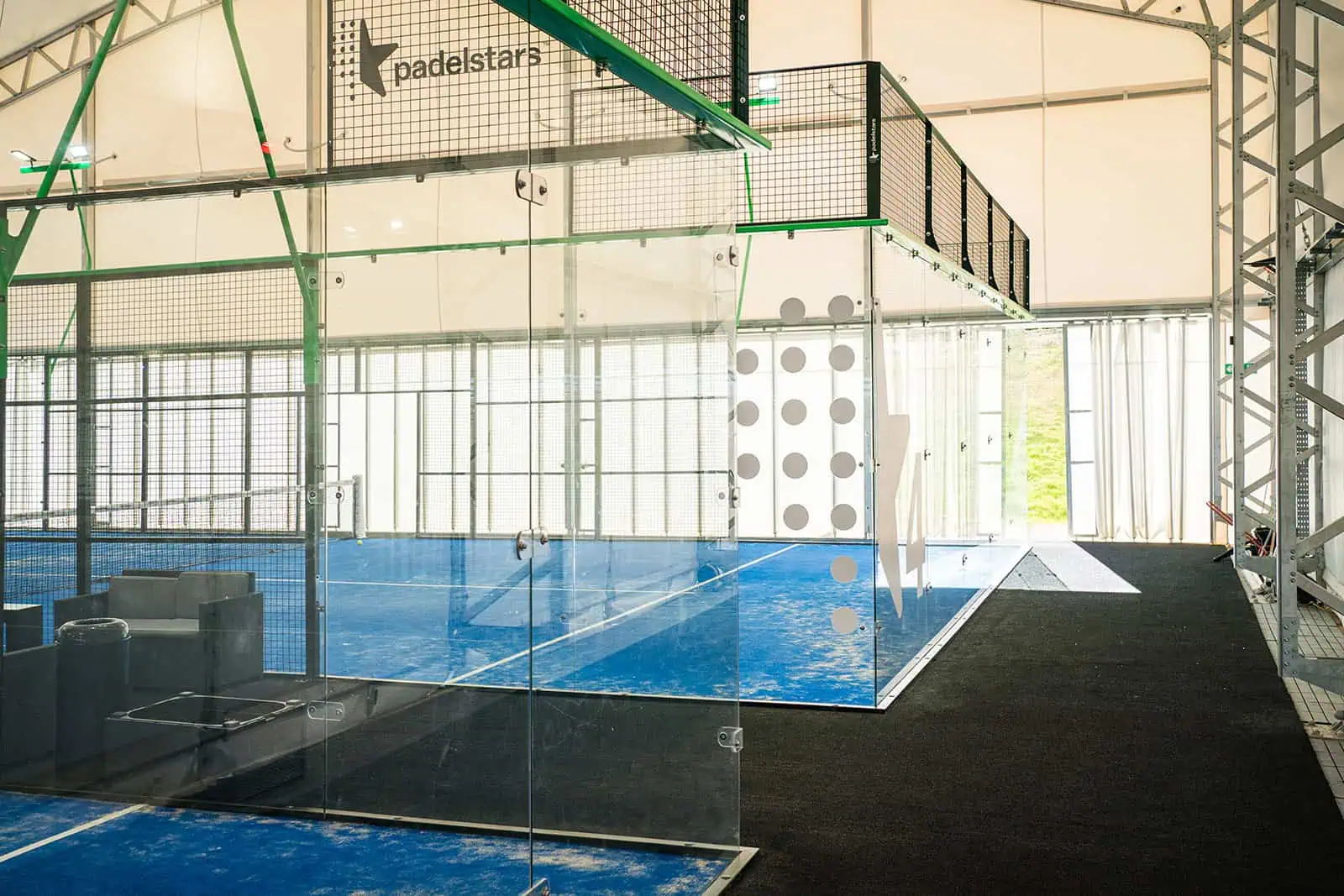
Seven metres is often quoted as the minimum ceiling height for indoor padel. In practice, this is only just adequate and frequently restrictive.
Proper performance clearance depends on several factors:
• Lighting fixture depth
• Roof beam locations
• Net height tolerances
• Lob trajectory during competitive play
In real-world installations, a clear height of eight metres or more delivers a noticeably better playing experience. Lower heights increase glare risk, restrict lob play, and limit lighting design options.
Warehouses often appear suitable until structural beams or services reduce usable clearance. These constraints must be assessed early, before layout decisions are made.
Warehouse conversion is one of the fastest-growing areas in indoor padel construction. It also carries the highest technical risk.
Key issues include:
• Slab load capacity
• Floor flatness and tolerance
• Roof height variation across spans
• Fire escape routes and travel distances
• Accessibility compliance
Many industrial slabs were never designed to withstand point loads from steel-framed sports structures. Detailed assessment is essential. Level tolerances must be extremely tight to ensure consistent ball bounce and frame stability.
Fire strategy is also critical. Court layouts must allow clear egress paths without obstruction. Emergency lighting and signage must be integrated into the design from the outset.
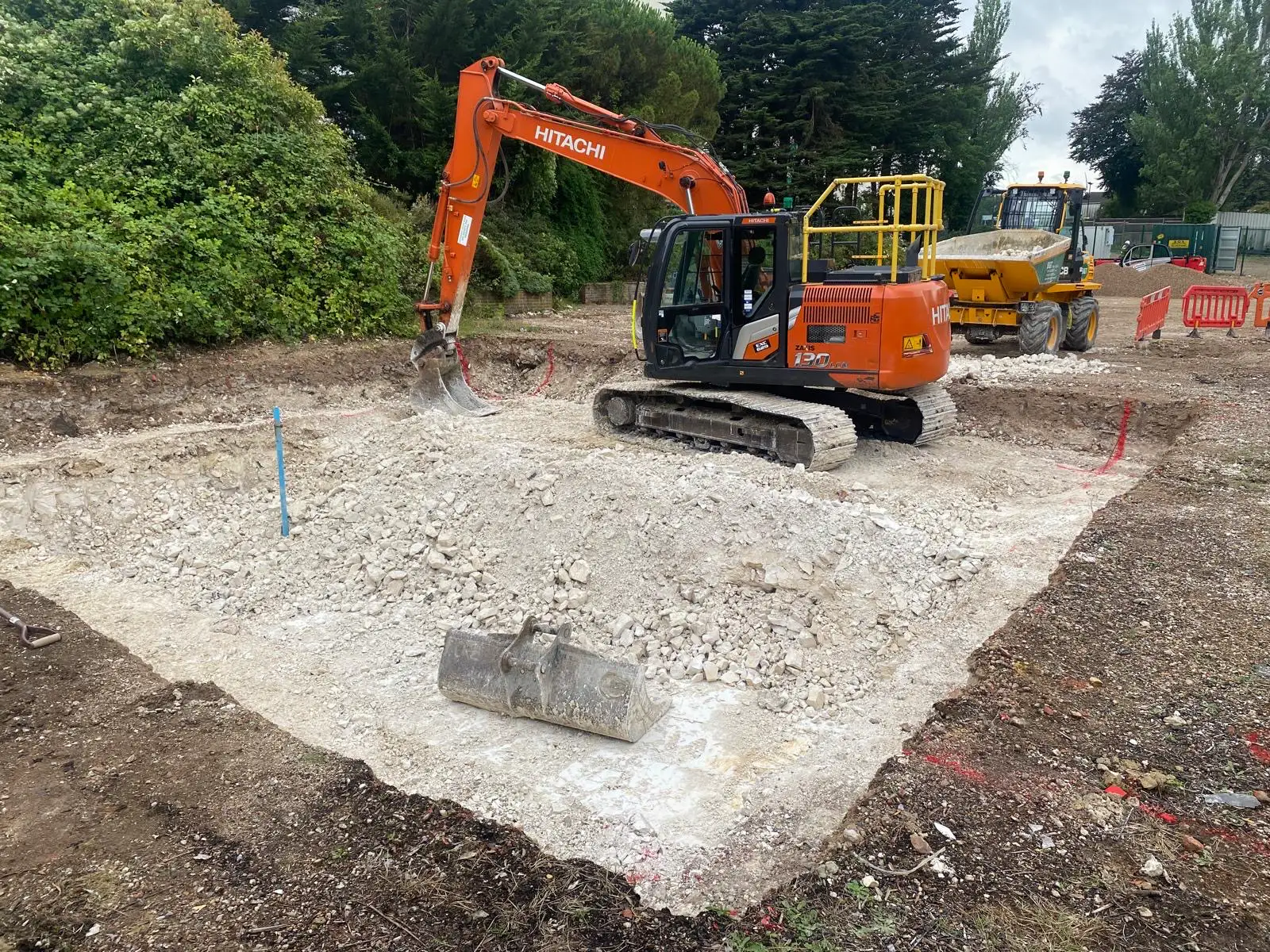
Indoor courts demand greater slab accuracy than outdoor installations. There is no tolerance for settlement or drainage slope.
Key requirements include:
• Reinforced concrete slab
• Minimal deviation across the whole court area
• Isolation between the slab and the surrounding structure
• Vibration control beneath steel frames
Vibration transfer is often overlooked. Without isolation, impact energy travels through the slab and structure, increasing noise and accelerating wear.
Precision slab preparation protects the court geometry for decades, not just the first season of play.
Five hundred Lux is widely accepted as the baseline illumination level for padel. However, Lux alone does not define good lighting.
Critical lighting considerations include:
• Uniformity across the playing surface
• Glare control near glass panels
• Reflection from steel and glass elements
• Colour temperature and visual comfort
• Emergency lighting integration
Indoor courts suffer when the lighting is placed too low or too close to the glass. Poor positioning creates visual fatigue and uneven contrast, especially during fast exchanges.
Professional lighting design uses photometric modelling to place fixtures precisely, not evenly.

Condensation is one of the most common indoor padel failures in the UK climate. Warm humid air meets cold glass surfaces, and moisture forms rapidly.
Effective control requires understanding:
• Moisture generation from players
• Dew point variation through the year
• Airflow direction across glass panels
• Heat builds up from lighting systems
Passive ventilation is rarely sufficient. Mechanical systems are usually required to maintain stable humidity and temperature. Dehumidification and extraction must be explicitly designed for the space’s volume and use profile.
Without this, glass visibility degrades and turf performance suffers.
Padel is an impact sport. In enclosed spaces, sound reflects and amplifies quickly.
Acoustic control focuses on:
• Impact noise from ball strikes
• Reverberation time within the hall
• Structural vibration paths
• Noise transmission to adjacent spaces
Solutions include isolation joints, acoustic backing behind glass, and sound-absorbing surfaces within the building envelope. Retrofitting acoustic treatment is costly and disruptive, so it must be designed in from the start.
This is also a key factor in securing planning approval for mixed-use sites.
Indoor padel turf behaves differently from outdoor systems. Temperature stability and reduced UV exposure affect fibre performance.
Best practice includes:
• Monofilament turf systems
• Controlled sand infill levels
• Consistent shock absorption
• Predictable ball speed
Surface selection must align with lighting and humidity conditions. An overly fast surface combined with poor lighting increases injury risk and reduces play quality.

Indoor padel courts in the UK must comply with building regulations, not just sporting standards.
Key areas include:
• Fire safety and exit provision
• Emergency lighting and signage
• Accessibility requirements
• Structural certification
Early coordination with building control avoids redesign delays and ensures the facility can operate legally and safely.
Indoor padel courts cost more than outdoor courts for clear reasons.
Primary cost drivers include:
• Mechanical ventilation systems
• Complex lighting installations
• Structural modifications
• Fire safety compliance
• Acoustic treatment
Understanding these costs early helps clients make informed decisions about layout, number of courts, and long-term viability.
Indoor padel construction rewards specialists. Experience matters more indoors than outdoors.
A specialist contractor brings:
• In-house engineering expertise
• Proven indoor installation experience
• Planning and compliance knowledge
• Integrated design coordination
This reduces risk, protects performance, and ensures the finished facility delivers consistent value over time.
Indoor padel courts succeed when every technical decision is made with performance in mind. Height, lighting, ventilation, acoustics, structure, and compliance are inseparable.
A well-designed indoor court plays better, lasts longer, and attracts repeat users, whereas a poorly designed one struggles from day one.
For anyone considering indoor padel court construction in the UK, specialist knowledge is not optional. It is the foundation of long-term success.
The practical minimum ceiling height is seven metres. Still, eight metres or more is recommended to allow full lob play, proper lighting placement, and safe clearance from roof structures and services.
Yes, but only after structural assessment of slab load capacity, floor flatness, roof height, fire safety access, and building services. Many warehouses require slab reinforcement and ventilation upgrades before courts can be installed.
Indoor padel courts typically require around 500 Lux of uniform LED lighting, with careful glare control and positioning to prevent reflections on glass panels and visual fatigue during play.
Condensation is controlled through mechanical ventilation and dehumidification systems that regulate temperature, airflow, and humidity to prevent moisture from forming on glass and playing surfaces.
Enclosed spaces amplify impact noise from ball strikes and player movement. Acoustic treatment reduces reverberation, improves playing comfort, and helps meet padel court planning and environmental noise requirements.
Looking to bring padel to your home, school, or sports facility?
At Lofthouse Padel Court Specialists, we design and build premium courts tailored to your space, goals, and budget. From planning permission to professional installation, we handle everything with expertise and care.
Get in touch today to start your padel court project with trusted UK specialists.


We provide our clients with comprehensive turnkey solutions, managing everything from initial planning applications and groundworks to full construction and finishing touches - so you can stay focused on the game.


Registered in England & Wales | Company No. 11269888 | VAT No. GB 30 1554 934 | Privacy Policy
Powered by Construct Virtual website design and hosting
With over 20 years of experience in the construction and housebuilding industry, Richard has led Technical, Planning, and Design teams for construction and PLC housebuilders. Having assisted in the delivery of key developments such as Kew Riverside and Grosvenor Dock in Chelsea, and managing projects ranging from 50 to 750 homes, complete with schools, sports facilities, and retail units.
His experience spans bespoke high-end homes, retail and commercial schemes. He has also contributed to innovative projects like the Northstowe new town near Cambridge and is a strong advocate for modern construction methods.
With over 25 years of experience in finance and office management across sectors including healthcare, logistics, and construction services, Carole has overseen full finance functions for organisations ranging from SMEs to multi-site charities. She has managed payroll for over 130 employees, implemented credit control procedures, and prepared management accounts through to trial balance.
Her experience spans both strategic financial oversight and hands-on administration, including bank reconciliations, pension submissions, budget management, and diary coordination. A proficient user of payroll and accounting software, she has also liaised with external accountants to ensure smooth year-end processes and compliance with tax regulations.
Carole is a highly adaptable professional, with a strong background in credit control, payroll, and office operations, and is valued for her attention to detail, reliability, and ability to streamline processes in fast-paced environments.
With over 30 years of experience in the construction industry, Kevin is a seasoned Contracts Manager specialising in RC concrete frames and groundworks. Starting his career on-site and progressing through roles in both construction and contracts management, he brings a deep understanding of every phase of project delivery.
Notable high-profile projects that he has worked on include Battersea Power Station and the O2 Arena, where he played a key role as a construction manager. In addition to commercial landmarks, Kevin has also contributed extensively to residential construction, overseeing the groundworks and installation of superstructures for private bespoke homes.
His dedication to quality, safety, and efficiency continues to drive excellence across all aspects of his work.
James Bourke brings 30+ years of experience in the construction industry, managing groundworks projects exceeding £100 million. As London Regional Director at O’Keefe Construction, he scaled the business unit from £12 million to £60 million in turnover. At Deep Contractors, he launched a business unit generating £20 million in profit.
His portfolio includes prestigious developments such as:
James’s leadership has been instrumental in driving growth for clients such as Vastint, Barratt, and Berkeley Homes.
After graduating from Cardiff University, Ryan joined Walsh Associates as a structural design engineer, focusing on high-rise reinforced concrete structures in London.
He later became a project engineer, managing key developments like Lombard Square (1,750 units) for Berkeley Homes and Ballymore. His role involved liaising with contractors, ensuring design information met project deadlines.
Now transitioning to the contractor side, Ryan aims to leverage his consultancy experience to bring a fresh perspective and enhance efficiency in the fast-paced construction industry.
Jayne brings extensive business expertise to Lofthouse Construction Group, having successfully founded, expanded, sold, and integrated businesses in her role as Chief Operating Officer.
She led key functions—including Finance, IT, Marketing, HR, Legal, Administration, and Project Management—driving innovation and operational excellence.
At Lofthouse Construction Group, she is focused on implementing structured processes, systems, and disciplined approaches to support the company’s rapid growth and exceptional team.
Steve brings 35+ years of experience in the construction industry, specialising in grounds, basements, and concrete frames of up to 14 stories.
He has successfully managed numerous multimillion-pound projects for leading companies such as Balfour Beatty, Kier, Wates and Taylor Wimpey, overseeing teams with 110 personnel.
He has 35+ years in property development, specialising in bespoke projects like luxury apartments.
His roles at Antler Homes and Millgate Developments have refined his expertise in procuring high-end materials.
As Procurement Manager, he ensures superior quality and value across all projects, enhancing client satisfaction.
Daniel has 18 years of experience in the construction industry, with strong expertise in Estimating, Commercial Management, and Structural Steelwork. He has worked across Groundworks and RC Frame projects from design to installation, managing sub-contract packages exceeding £5 million on high-rise residential developments in London, as well as major rail and commercial projects including Crossrail, Heathrow, and Gatwick Airports.
Sharp, with an inquiring mind and prodigious attention to detail, Ann's successful career started in the world of banking, with roles in financial advice and management.
This expertise was put to excellent use, enabling a move into high-level finance and accounting recruitment for investment behemoths such as Citibank, Deutsche Bank, Merrill Lynch and technology giant NTL.
After taking a career break, she played a significant role in developing two bespoke, accessible homes while raising two beautiful children.
Ann's focus is now on talent acquisition, retention, and systems management in the demanding Lofthouse Residences HR & Operations Manager role.
He has 30+ years of experience in construction.
As Commercial Director (QS), he oversees project stages from acquisition to completion.
Previously, he was Senior QS at Millgate Homes and Partner at Quantum Merit Associates.
His expertise drives profitability and operational efficiency for sustainable growth.
Paul Beaney has 30+ years of experience in the construction industry, beginning his career at Berkeley Homes before becoming Managing Director at Millgate Homes.
During his tenure, he contributed to the rapid growth of the company, overseeing the construction of over 1,200 homes, which ultimately led to Millgate Homes' acquisition by Countryside.
Currently, as Strategic Director at Lofthouse Residences, Paul leverages his extensive network of suppliers, subcontractors, architects, and land agents to shape the company’s long-term vision.
His strategic insights and industry expertise are vital for driving continued success and ensuring robust growth in a competitive market.
David Lofthouse brings 20+ years of investment banking experience to the construction industry, seamlessly transitioning his financial expertise into luxury property development.
After successfully creating two bespoke luxury homes, he founded Lofthouse Residences, driven by a vision to transform the sector.
David leverages his strategic insight to establish a business that offers concierge-level service, setting new benchmarks for innovation, creativity, cost-efficiency, and quality.
His commitment to excellence and ability to navigate complex financial landscapes position Lofthouse Residences as a leader in the luxury market, ensuring sustained growth and exceptional value for stakeholders.